All about product


Text in the video: Hello. These are PRO locks, series 73, made/spread in Greece and Italy. They are similar in profile to the PRO-49 and PRO-49A. There are photos on the website. You can look at them to see if you can tell them apart.
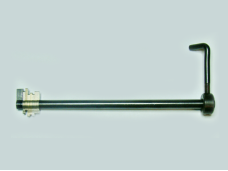
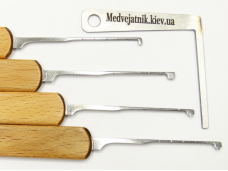
There are differences: the interactive element, the different waveforms, and the pin within the pin. Now for the tool. The tool is a universal waveform, and it also has an interactive element.
Opening is almost 100% guaranteed. We use extremely thin foil here. Foil number 4 (that is, 0.04 mm). It's soft and thin.
If we use a fifth foil (0.05 mm), it will take a long time to open. That's why the main foil here is 0.04 mm. Opening even with 0.04 mm foil takes some time.
I would use 0.05 mm when the lock quickly jams or is difficult to open, then we use 0.05 mm. We make a shape on the back side, shape it. You can even overlap it here. Like this, so the foil lies on the side here. The 0.04 foil is thin, so you have to be careful with it, but it allows you to open the lock more quickly. Pull it to the left and pump it up and down.
The tool is extended. This distance is designed to make it easier to pump, so your hands don't get tired.
There's the click.
That usually means the pins have fallen into place and all that's left is to complete the rotation.
If you feel a significant amount of play, apply a little more force and break the wave.
The lock remains fully functional afterwards.
So, in most cases you'll be using the 0.04 mm foil with left-hand tension while rocking the tool up and down.
If the lock has been opened before, the wave will usually break quite easily.
If it's being opened for the first time, wait until you get a good amount of play like this, then give it a firm twist to break the wave.
The locks will still remain fully operational.