All about product
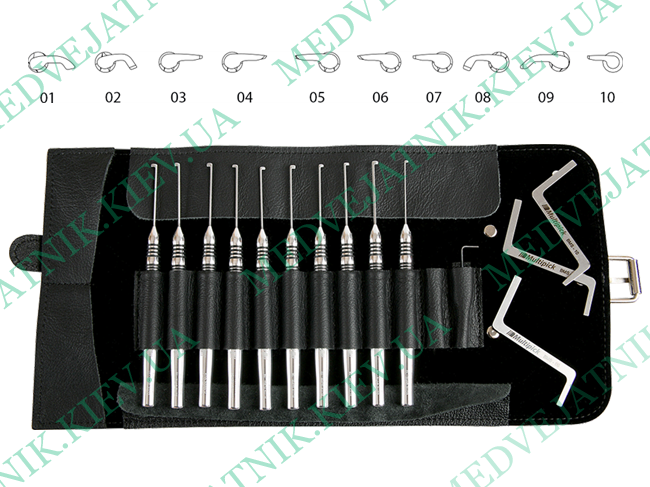
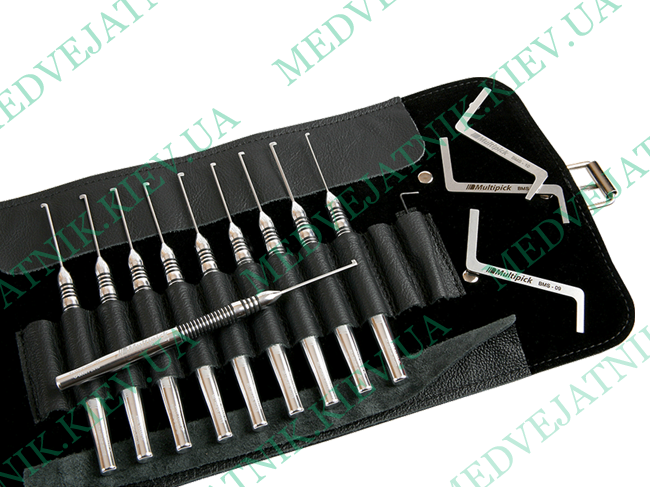
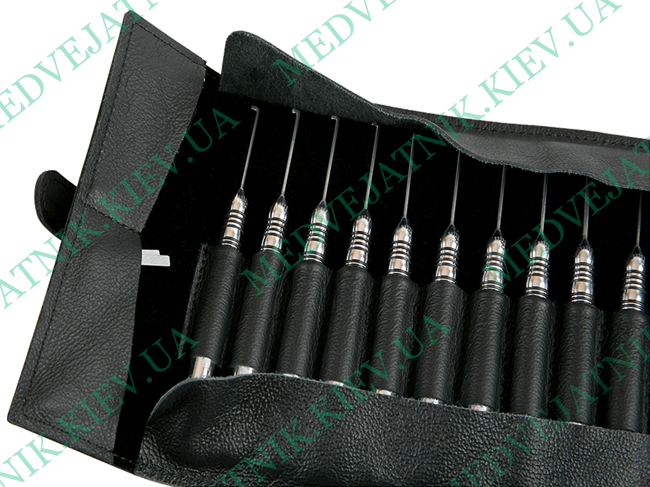
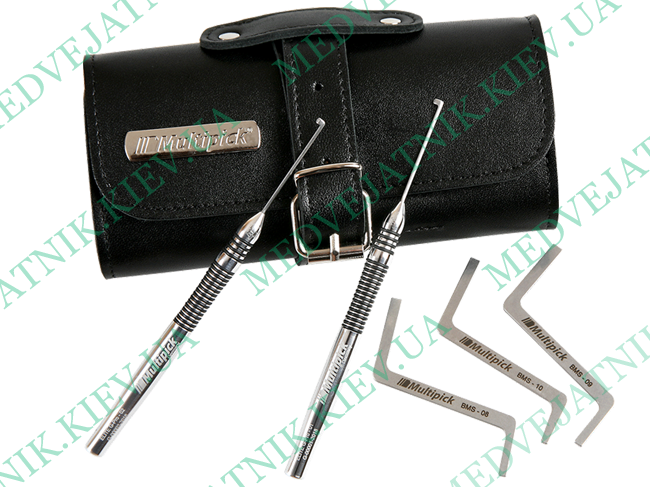
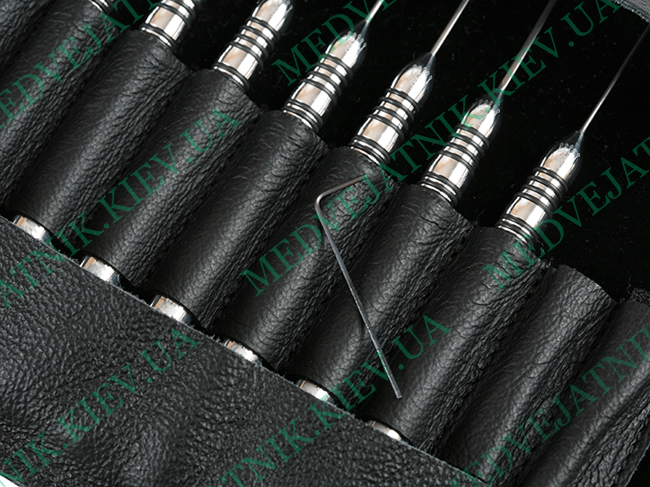
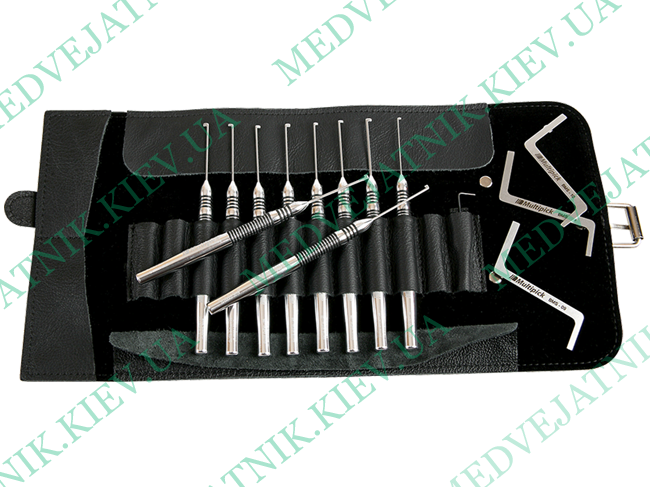
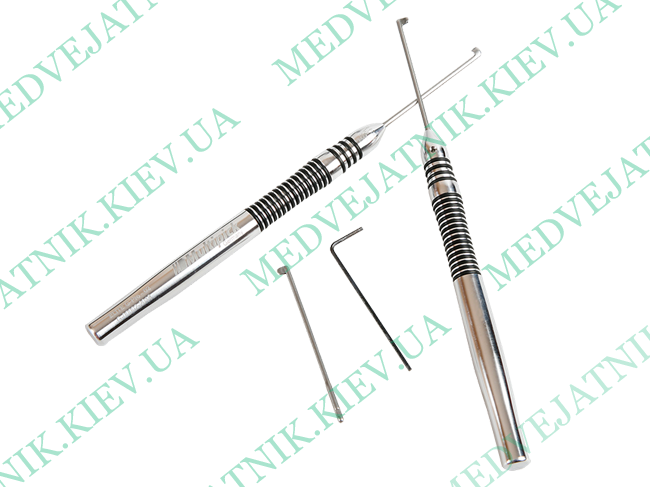
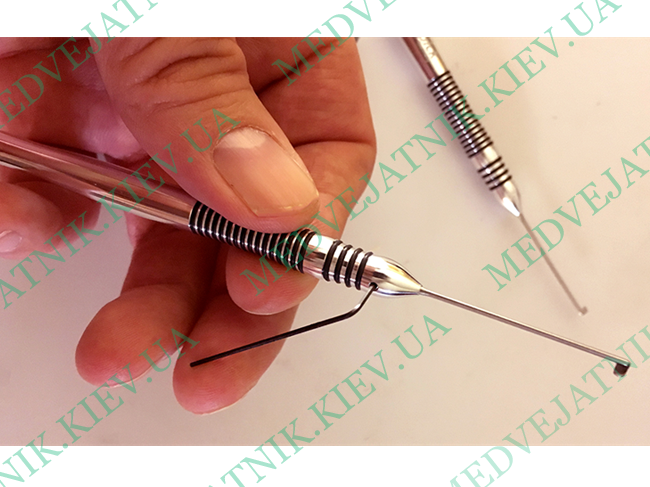


ELITE G-PRO Dimple Pin Lock Pick Set - in a fine genuine leather roll-up case
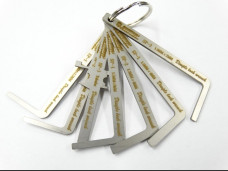
The Multipick ELITE G-PRO is the ultimate dimple lock pick kit for the professional lock picker.
The highest-quality manufacturing and the finest materials allow unprecedented feedback when picking.
The ELITE G-PRO is distinguished by its outstanding quality:
- finest polished tips in many variations for the widest variety of locks
- maximum feedback - maximum transfer of pin behaviour to the user
- extremely stable, yet light and easy to handle, just like a spring
- microelliptic blade shanks in various diameters for the perfect turning point
- non-slip, fatigue-free and lightweight handles made of the finest rubberized aluminium
- exchangeable and individually available tips to safeguard the investment
- made in Germany.
Text in the video: Hello. These are new professional expensive locksmith hooks, a set of hooks. Even the case is expensive here, it's real leather, everything is coolly done. There are three tensioners and 10 locksmith hooks. There are no questions about these hooks, they are really cool and high quality. It’s even rubberized, the bends are done perfectly. These are one of the best for the job. I will not open anything now, because I think everyone understands how it works. I'm just showing that they've already been on sale. Well, here the profile is probably not so visible, but on the website there will be a picture of the shape of these bends, here the right and left ones. The price of the set will be on the website, the link is under this video.
Text in the second video: Hello everyone, we are from Ukraine. What do we have today? Today we have a case, quite practical, but with elements of glamour. A case for rake picks and the rake picks themselves. This is a tool for working with cylinders with a perforated profile. Well, let's figure it out little by little. So, according to the cutting method and the location of the keyhole, cylinders are divided, well, we conditionally divide them into two types. We call such cylinders with a vertical keyhole English, in some regions they are called French or, for example, flat. And these are cylinders with a horizontal keyhole. They are also called differently, also laser, but we call them perforated. So, what do we have? We have a set of tools for working with such a cylinder profile. Got it, great. What kind of tool? A tool from the Multipick company. There was even a brand name somewhere here. Multipick. Well, let's go step by step. Completeness. The case itself. Then 10 rake picks. Again, why rake picks? Well, they are also called differently, Hooks, Sticks. Well, let's stop at rake picks. 10 rake picks with different needle profiles. With different shapes. But we'll figure that out later. What else is included? The set includes three tools for loading, tensioning. Well, the so-called tensioners. They are signed, they are of different thicknesses. Well, for me, for example, it is not very convenient to work with them, so we'll put them in place. What else is in the set? Jig An ordinary jig that works with goujons. Here is a goujon for attaching the needle itself. And a jig to unscrew and screw in. As a result, three tensioners, a case, a jig and 10 picks. And now here's the most interesting part. Let's look at the rake picks. All with identical handles. What is a handle? It is aluminum, quite light, ergonomic. It is very convenient to work from both sides. Convenient. It has rubber rings inserted into the aluminum. I don't know how durable they are, but they are very pleasant in the hands. The friction increases. The brand name Multipick is written on the handle itself. And there is also information on the rake pick model itself. That is, the model is written on each rake pick. For example, here is G PRO 03. Well, that is, this is 03, 05, 04. This is each rake pick model. It is very convenient that the model is signed. Now the profiles. What is interesting to us in general? Naturally, each country has different cylinder profiles. Look at the shape of this particular rake pick, the shape of the spout itself. Of course, it is very difficult to cover all the profiles, or to make everything convenient for yourself. Everything depends, of course, on the operator's manner of work and his skill. Just on how exactly he works. And what profile. There are 10 profiles here. The needles themselves. The needles themselves are quite rigid. But most likely they are made with baking. Or, well, I don’t know. Some kind of printer. All because they are made very identically. Very neat. What profiles are there? If we stopped at the profiles. And the profiles of these noses. 4 units turned to the left. And 6 units turned to the right. So we call the left and right profiles. I’ll correct it a little. So. 4 left. 6 right. Of which on the left profiles 2 straight picks. And 2 like this with a bend. I’ll show this later. On the right profiles 4 straight picks. Which go by size. Here is the largest one. And they go down. That is, the nose is getting shorter and shorter. And 2 with a bend. Well, let's see what all this is for? And how does it work? In general, how is it. Well, let's take a cylinder. This is a 7x7 cylinder. This cylinder has a feature. What feature? It has a fairly wide open profile. And to work with it, you need a fairly long pick. On the left side. Here, in this version, two are suitable. In this set, two picks are suitable for this cylinder. So, I'll take one. Well, let's see how well it works there. I immediately pay attention to length. There were questions. The length is enough to get under the protector. Now at this point the stick is on the last pin. That is, there is still enough space under the protector. Now the last pin, which needs to be pressed down best. And the pick successfully coped with this. That is, the length of this nose is completely sufficient to work with the deepest pin. Well, the cylinder is, let's say, simple. We'll put this pick aside for now. Let's take another one of the same picks for the left side. That is, I'll take two. One is a little wider. Can you see? One is a little wider. The other is a little narrower. Why am I taking this? Because I want to try working with these same sticks on Multilock Classic cylinders. If in this case there was a Multilock 7+7 cylinder. . Now let's take the Classic cylinder. And let's try to work in the same way. As always, I'm sitting somehow on the edge. It's not entirely comfortable for me. So. Classic cylinder. The key is not original. Well, let's move on. We tighten. I took a wider pick. Well, to be honest, it fits quite problematically. For example, I would grind it a little. But since the tool is not mine, I will not. I am working only with a wide one for now. Here is my last pin. Now I will try to get under it. But nothing happened. Let's try again. The only problem in this case is getting under. Excellent. Good. As we can see, I am generally working with only one pick so far, a wide one. Well, it copes with Classic cylinders, which is good. But the nose of this thickness of the metal itself, as for me, is a little too much. Therefore, I would recommend not to be afraid to sand a little. So, with these profiles everything is clear. Let's move on. We worked with straight profiles. Now we will take a bent one. Why do we need this bent one? I have one favorite one there. These are straight ones. I want a bent one. This is a bent one. This is the bent profile. Here the nose is slightly bent. Can you see it? This pick is needed to work with such profiles. I will show now. Such a profile as in Turkish cylinder KALE. Here it is the profile.It's so chopped up. The same profile in Eseo, Apecs, ITO cylinders. Well, such a chopped profile like this it is spread. Well, let's try. Here's the key. I don't know. These are also not original keys. Well, let's try to see how much it will fit and move there. So there is something. There is something here too. So, the second, second, fourth, sixth. As far as I remember, mushroom-shaped. I'll try to Put the second one right away, mushroom-shaped. And the third one, bald. It worked. Let's try to turn the fourth mushroom-shaped one now. I just turned it now. Something flew out. The first one flew out, bald. There is enough length. And the last sixth one. Let's try to turn it too. Everything is fine. There is enough length. The tool is a little new for me. I feel a little uncomfortable working with it. But. Because it's new. And as we can see, it fits everywhere. Everything is good. That is, this bent pick works very well on such profiles. There is another bent one. Even with a larger bending angle. I tried working with Cisa, with ABUS. It works very well. But unfortunately, I don't have any cylinders at hand right now. Now we'll move on to the right ones. What do we have on the right. Let's start with the straight ones. That is, the straight picks. Which work on the left side. The nose is bent. And they work on the right side. Well, here I have some cylinder. Chinese one. Judging by the look of the cylinder (it's shiny), you can conclude that it's Chinese. I don't know how they polish it there. But how can they get such a shine. As you can see, I work with my own tensioners. Because these tensioners are a little uncomfortable for me. I'll take a simple Chinese tensioner. The very simplest one. And I'll go in from the right side. It needs to be comfortable. The cylinder actually went in so tightly. I probably need to sit more comfortably somehow. Yes, I sat a little uncomfortably. Totally uncomfortably. It's okay. China is China, no matter where you are. A mushroom, or something? I don't get it. And some other mushrooms. There were some other mushrooms in it. I'm shocked. And I'll try to use this same master key. Although I had one thinner there. In general, there is one slightly thinner. One slightly wider. I'll try to use this one on narrower cylinders, like the ABUS Bravus. That is, there's not much space here. The pins are high. I'll try using the same pick. What kind of tension should I take? Let's try this. So here we go. I sat a little more comfortably already. Because something was really uncomfortable. So. Here it is. Here it is too. Oh, and we also have mushrooms there. Here it is. Good. There is something else figured here. And figured here. Well, we see that everything fits through too. Everything is good. That is, in principle, what I like about Multipick is that essentially nothing needs to be finished. That is, the tool is already ready for work. That is, just do some cosmetic work. Sand it a little here. With a thousand-grit sandpaper there. Or just do it there. That is, everything is ready for work. So. Let's put all these cylinders aside. Let's get back to the set. We looked at the left side 2. We looked at the right side 3. Yes. That's the story. What's in this set. On the right side, these are the profiles that go to the left side. The profiles that bend. Honestly, I don't have such cylinders at the moment. And time is a bit limited. That is, in essence, what we have. What I liked and what I missed. First, what I missed. If there are 6 profiles here, then there are 4 here. It is these two short profiles, like on the right side, that I missed on the left side. I think that in principle we have many cylinders that have such profiles. It is these two picks that I missed. The most interesting thing is that there are two additional holes. Just for these picks. And what I liked for the most part. I liked the fact that everything is already ready. That is, you take it, use it, everything is sturdy, comfortable, cute and a very practical and beautiful case. So basically, what can I say. I can recommend this set. A good ready-made solution. The only thing is a big BUT. This is its price. The price is not very cheap. But then again, I work with my own tool. I do it myself. Of course, this is still a matter, I repeat, of habit, work manner and operator skill. To each his own. That's all. If this video was useful to someone, then of course you owe me a royal like and a subscription. And so, good mood to everyone and peaceful skies!